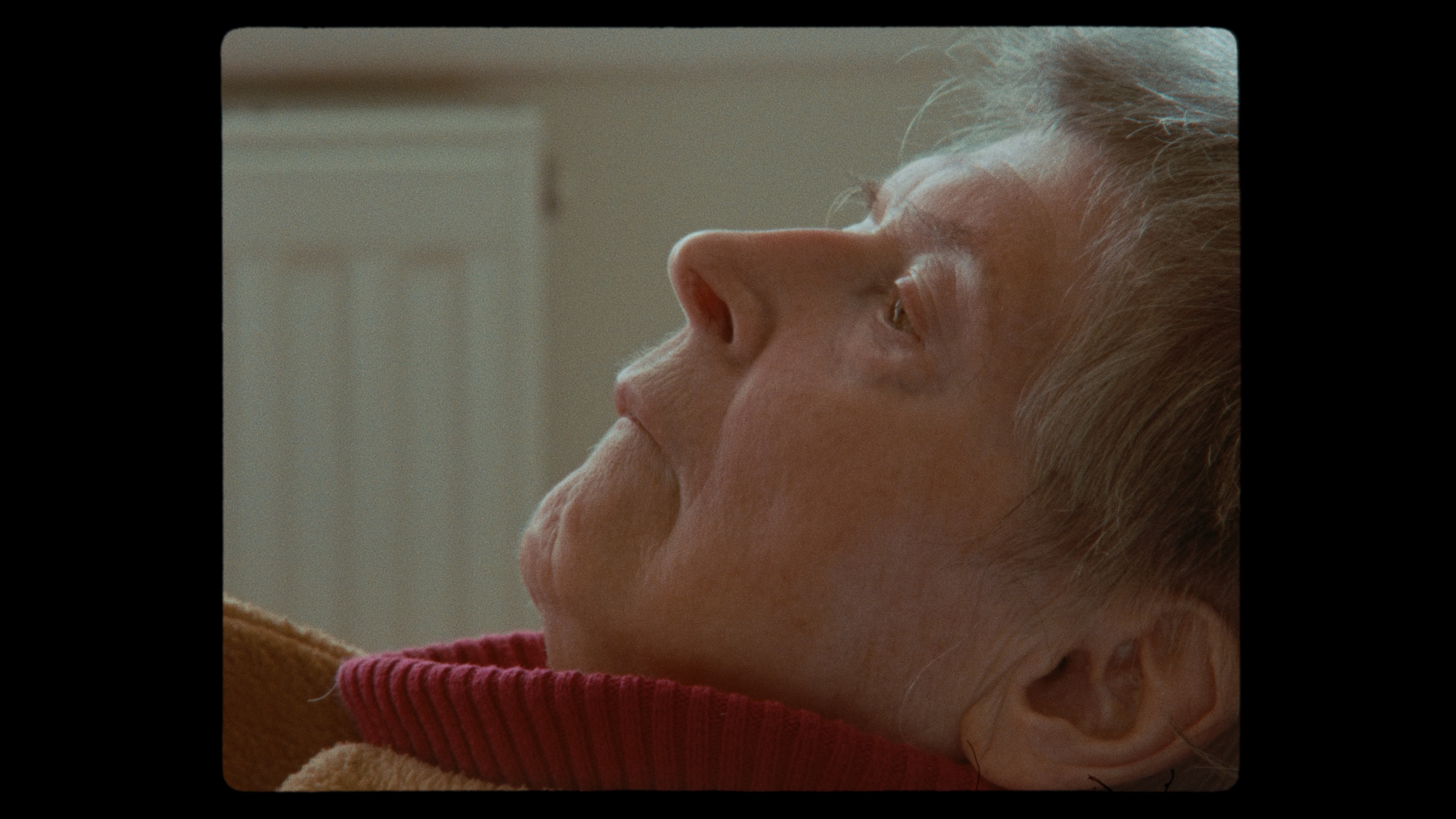
A Sensation Never Yet Known is a new work by Luke Fowler. It explores the history of electronic music in Scotland through a film portrait of Janet Beat, a pioneering composer and educator whose contribution has been overlooked until recently. Filming the now 88 year-old Beat over the course of a year, Fowler uses film as a medium that attests to presence: of Beat in the here and now, of the camera within her domestic space, and of her life’s work within the larger context of experimental music. Rather than a biographical or narrative work, A Sensation Never Yet Known weaves together moments of conversation. We hear Beat recount her childhood experiences of listening to the natural world, her graphic scores for dancers and the obstacles she faced as a female composer of electronic music. If attentive listening has been central to her work, attentive listening and looking is the foundation of Fowler’s project as it traces the collected objects in Beat’s home, the natural world and animal life that surrounds her, and the ever-present potential in her musical scores.
Extending his long-standing interest in how cultural and political figures of the 1960s and 1970s are remembered, ‘A Sensation Never Yet Known’ also reflects Fowler’s practice as both an artist-filmmaker and a musician in his own right.
On Janet Beat:
Janet Beat was born in Streetly, Staffordshire on 17 December 1937. She graduated from Birmingham University in 1960, with a Bachelor of Music degree. During the 1960’s she worked as a freelance horn player and teacher while writing her postgraduate thesis on aspects of early Italian opera. Beat, a contemporary and peer of Daphne Oram, was one of the first generation of women pioneers in electronic music composition in UK.
She introduced electronic music in the 1960s first at Worcester College of Education with the help of the science department whose technician built some filters, a ring modulater and loaned a signal generator to her until the EMS Synthi A became available.
In the 1970s, she established Electronic Music & Recording Studios for the Royal Scottish Conservatoire, (formerly the Royal Scottish Academy of Music and Drama), where she joined the full time staff in 1972 but from 1991 she went part-time in order to concentrate on composing and performing with the electro-acoustic ensemble SOUNDSTRATA (1989-1993)
In 2019 She received a SWIM Lifetime Achievement Award as a composer, music educator and writer on music.